INDUSTRY INSIGHTS
That’s the paradox at the heart of India’s healthcare transformation. We have robots dispensing drugs, AI reading scans, and digital health missions connecting millions — yet when it comes to evidence-based decision-making, our system still runs on instinct, memory, and the occasional WhatsApp forward.
The Illusion of Smart Healthcare
Globally, it takes an average of 17 years for new medical research to become standard clinical practice — and often 20 years or more in India, especially outside metropolitan cities (Balas & Boren, JAMIA; WHO Policy Brief, 2023).
That means a discovery made today could take a generation to truly benefit patients.
Meanwhile, the world’s research engine is producing more knowledge than any human can absorb. The National Library of Medicine adds over 10,000 new papers every day. Even if a doctor reads one article an hour, it would take eight lifetimes to catch up. Knowledge is exploding; time is not.
VIVEK SLARIA
CEO, OneRX
The problem isn’t just information overload. It’s information inequality. According to NITI Aayog’s Health Workforce Report (2023), nearly 70 per cent of India’s 12 lakh doctors practice in Tier 2 and Tier 3 cities — serving most of the nation’s patients but receiving only a fraction of up-to-date evidence or journal access.
An ICMR and WHO India study in 2024 found that 58 per cent of non-metro clinicians first hear about new drugs or treatment updates through informal WhatsApp or social-media groups.
So while AI writes new protocols, doctors in smaller towns still rely on forwarded PDFs and peer chat groups to stay informed.
That gap is not about talent — it’s about access. Evidence inequality is the new healthcare inequality.
When the Problem Becomes Personal
For me, this issue isn’t theoretical. A few years ago, my father was diagnosed with metastatic melanoma. His oncologist — highly skilled, deeply committed — spent nights searching international databases for treatment guidance.
Eventually, he found an article from Australia that informed the next step. It helped, but it also left me with one question:
Why should an Indian doctor have to go halfway across the world to find the right evidence?
That moment changed how I viewed innovation.
Because despite our smart machines and digital dashboards, the connection between evidence and everyday clinical practice remains painfully weak. We’ve digitised hospitals but not decisions. We’ve connected devices but not data.
NOVEMBER 2025 eletsehealth @ehealthonline eletsehealth eletsvideos Connect with us on
NGlobally, it takes an average of 17 years for new medical research to become standard clinical practice — and often 20 years or more in India
INDUSTRY INSIGHTS
The Hidden Cost of the Evidence Gap
The lag between research and real-world adoption isn’t just an academic issue — it’s an economic one.
A 2025 Onerx analysis estimates that delayed evidence adoption costs India’s healthcare ecosystem ₹6,000 – ₹8,000 crore annually, through inefficient treatment choices, brand switching, and readmissions.
An ICMR prescription audit (2023) found that one in four prescriptions in district hospitals deviate from the latest clinical guidelines. Not because doctors don’t care — but because updated evidence doesn’t reach them in time.
In other words, India has data everywhere but intelligence nowhere.
The Question That Sparked OneRx
How do we make sure a doctor in Patna or Pune can access the same cited evidence as a doctor in Boston?
How do we make medical knowledge move at the speed of care — not the speed of journals?
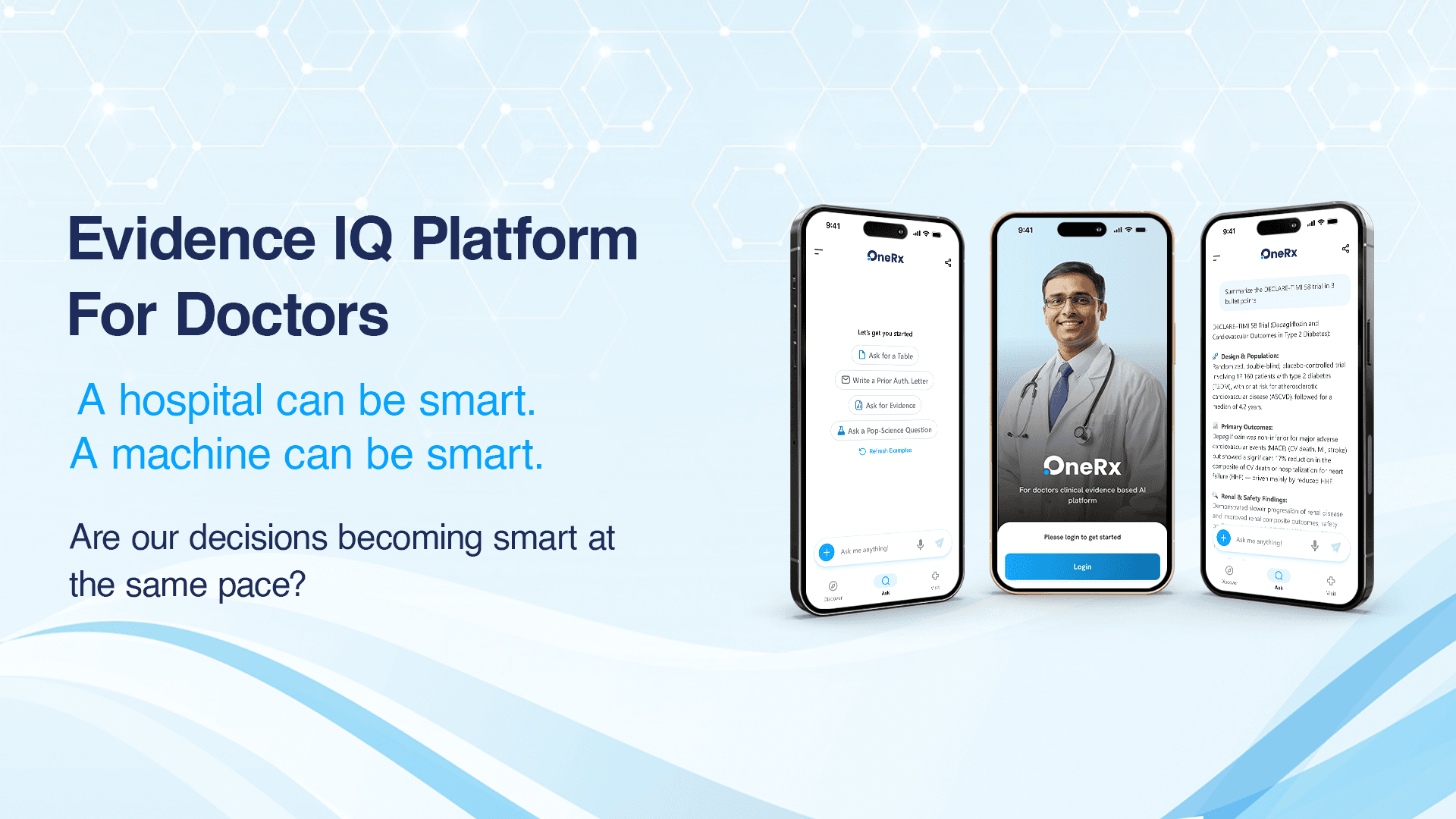
That’s the question that led us to build OneRx — an evidence intelligence platform for doctors.
It isn’t another generative-AI chatbot or consumer app. It’s a medical-grade tool that retrieves, summarises, and cites peer-reviewed evidence in seconds — from trusted sources like ICMR, AIIMS, AIMA, JAMA, NGE, Nature and PubMed.
OneRx is accessible only to verified doctors, ensuring privacy, credibility, and clinical safety. It never diagnoses; it simply answers evidence questions.
Ask: “What’s the latest guideline on dual antiplatelet therapy in diabetes?”
Within seconds, you receive a concise, cited summary — not a guess. Views expressed by: VIVEK SLARIA, CEO, OneRX
Why Evidence Must Become Infrastructure
In today’s India, 70 per cent of patient care happens outside metros. If evidence doesn’t reach these doctors, innovation remains urban.
If we can deliver real-time, localised evidence to every clinician — from Gurugram to Guwahati — we can narrow the gap between research and recovery, between data and decision.
The future of healthcare won’t be defined by smarter hospitals; it will be defined by smarter evidence.
We need to treat evidence like infrastructure — as fundamental as electricity or oxygen.
That’s what OneRx aims to build: a national backbone for evidence access, where every clinician can make decisions backed by the latest science, in the Indian context.
Building India’s Evidence Ecosystem
OneRx is now in its pilot phase, partnering with hospitals, medical colleges, and early adopters across the country.
Participating doctors get lifetime free access to the platform and the chance to co-create India’s evidence infrastructure.
The response so far has been overwhelming — because doctors understand that this isn’t about technology. It’s about time.
Time saved in searching.
Time saved in deciding.
Time saved in healing.
From Data to Decisions
India doesn’t lack data; it lacks decision intelligence.
Smart hospitals, robotics, and telemedicine are transforming care delivery — but until our doctors have timely, trustworthy, contextual evidence, we’re still reacting, not leading.
If we can bridge that last mile between research and practice, we can redefine what “smart healthcare” truly means.
Not just connected hospitals — but connected knowledge.
Not just faster machines — but faster understanding.
Not just digital India — but intelligent India.
And that journey starts with one question:
What if evidence itself became our national healthcare
infrastructure?
References
- Balas EA & Boren SA, J Am Med Inform Assoc, 2000; WHO Policy Brief, 2023
- NITI Aayog Health Workforce Report, 2023
- ICMR & WHO India Digital Health Literacy Study, 2024
- ICMR Prescription Audit, 2023
- Onerx Analysis Report, 2025
- PubMed Metadata, 2024
NOVEMBER 2025 [ ehealth.eletsonline.com ] The Largest Portal on Healthcare Innovations in Asia and the Middle East