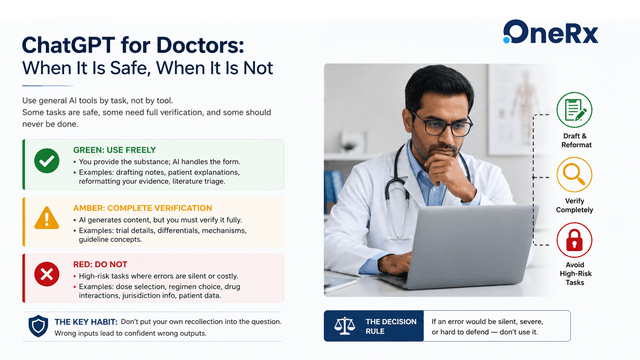
ChatGPT for Doctors: When It Is Safe, When It Is Not
On this page: Why prohibition failed · Green tasks · Amber tasks · Red tasks · The habit that matters most · Where OneRX differs · The decision rule · FAQ · References
Hospital policies banning general AI tools have mostly failed, and they have failed for an unglamorous reason.
The tools are useful, they are free, they are on the phone in the pocket of every resident in the building, and nobody is going to stop using something that turns a forty-minute discharge summary into a six-minute one on the strength of a circular email.
So the question worth answering is not whether clinicians should use these tools. That has been settled by behaviour. The question is which tasks a general model can safely take and which it cannot, and the honest answer sorts by task rather than by tool.
This is the operational companion to Is ChatGPT Reliable for Medical Advice? — that piece covers what the evidence shows about model reliability. This one covers what to do about it on Monday morning.
Green: use freely
The unifying feature of everything in this category is that you supply the substance and the model handles form, so an error is visible on reading rather than buried in plausible prose.
Drafting and restructuring
Discharge summaries, referral letters, structured notes from your own dictation. You are the source. The model is a formatter with good grammar.
Explanation and translation
Turning a regimen you have already decided on into patient-facing language in Hindi, Tamil or Bengali. The clinical content is yours; the language is the task.
Reformatting evidence you provide
Paste the guideline text and ask for a comparison table. The output is grounded in your input rather than in the model's memory, which changes the risk profile entirely.
Literature triage
Building search strategies, summarising an abstract you have supplied, structuring a journal club presentation.
Teaching material
Teaching material that you review before it reaches anyone.
Amber: complete verification, not partial
Here the model supplies substance, but you can check it quickly against a source.
Recalling a trial's design or primary endpoint, verified against the paper. Differential breadth, used as a completeness prompt rather than a ranked list. Mechanism-of-action explanations. First-pass orientation on an unfamiliar guideline concept.
The critical word is complete. Verification cannot be selective, and this is the part clinicians consistently get wrong.
In the largest oncology assessment of its kind, non-concordant recommendations appeared intermingled with concordant ones inside the same response — 34.3% of outputs contained at least one recommendation that did not match NCCN, sitting alongside content that did (Chen et al, JAMA Oncology 2023;9(10):1459–1462).
That study tested GPT-3.5 and the error rates have improved substantially since. The structural finding has not. If correct and incorrect content are interleaved, checking two lines out of five means you verify the two that were right.
There is a second reason partial checking fails. In current models, residual errors concentrate in complex conditional treatment algorithms rather than distributing evenly across a response (Meyer et al, 2026).
The questions most worth asking are the ones least worth trusting, which is precisely the opposite of what a spot check assumes.
Red: do not
Tasks where an error would be silent, the stakes are high, or you would have to defend the decision afterwards.
- Dose selection, particularly with renal or hepatic adjustment.
- Regimen selection and sequencing.
- Drug interaction checking.
- Anything jurisdiction-dependent — approval status, availability, coverage — where a general model will hand you a US answer without any indication that it has done so.
- Anything involving identifiable patient data, which under the Digital Personal Data Protection Act, 2023 constitutes a processing act governed by consumer terms never written for health information.
The habit that matters more than the tool
If you change one thing after reading this, change this one: do not put your own recollection into the question.
Researchers at Mount Sinai built 300 physician-validated clinical vignettes, each containing exactly one fabricated element — an invented laboratory test, a physical or radiological sign that does not exist, or a made-up condition. Everything else in each vignette was clinically sound. Six leading language models were asked to work with them.
The models repeated or elaborated on the planted fiction in up to 83% of cases. A dedicated mitigation prompt, explicitly warning that the vignette might contain false information, roughly halved the rate. It did not eliminate it (Omar et al, Communications Medicine 2025;5(1):330).
Translate that into a corridor between two clinics. You half-remember a threshold — an eGFR cutoff, a CPS score, a nodal count — and you type it into the question because typing it feels like giving context.
"In a patient with CPS 12, is pembrolizumab..."
The model does not challenge the premise. It accepts it and builds on it, fluently, in the same confident register it uses when it is entirely correct.
The tool has now amplified the exact error you consulted it to resolve, and nothing in the output looks any different.
So: describe the clinical picture and let the system retrieve the threshold. The moment you supply the number yourself, you have contaminated the answer before it started.
Where OneRX differs
The three properties that separate a general chatbot from clinical decision support software are not about medical knowledge. They are about provenance, currency and auditability, and each maps to a documented failure.
| Property | General model | OneRX |
|---|---|---|
| Provenance | Citations generated from weights; fabrication rates of 28.6–91.4% across tested models | Retrieved from an indexed corpus; every claim resolves to a document you can open |
| Currency | Answers from a training snapshot it cannot identify | Guideline version named on the answer, with corpus index date |
| Resistance to your own error | Elaborates on planted premises in up to 83% of tested cases | Answer anchored to retrieved source text rather than to the wording of your question |
| Jurisdiction | Returns a US answer without flagging it | CDSCO status, NPPA/DPCO price, PMJAY coverage and NCG tier attached |
| Defensibility | Not reconstructable months later | Retrieval trail available retrospectively |
That last row is the one clinicians underweight until the day it matters. If a decision is questioned eighteen months on, "the AI suggested it" is not a defence, and with a general chatbot you cannot even reconstruct what it suggested or on what basis.
NMC obligations on standard of care and record retention do not soften because software was in the workflow, and CDSCO's software guidance points the same direction — traceability of the decision process is the expectation for anything used clinically.
In building retrieval for Indian practice, the failure we encounter most often is not wrong medicine. It is correct medicine for a drug that is not on the shelf, not on the formulary, or not within reach of the patient in front of you.
That is why 1,400+ doctors across 8+ countries use OneRX at the point of care rather than a general model.
The decision rule
One question, before using a general model for anything clinical.
If the error would be obvious on reading — an awkward sentence, a mislabelled heading, a paragraph that does not follow — proceed. You are the safety net and you will catch it.
If the error would be silent, plausible, and buried inside otherwise correct text, use a tool that can show you where the answer came from.
Questions clinicians actually ask
Is there a safe alternative to ChatGPT for doctors?
Retrieval-grounded clinical decision support platforms address the core failure mode by fetching documents before answering, so citations resolve and guideline versions can be named. For Indian practice, the additional requirement is regulatory, pricing and coverage context attached to the clinical answer.
Can I use ChatGPT for discharge summaries?
For structuring content you supply, yes. You are the source and errors surface on review. Avoid entering identifiable patient data into consumer platforms, given DPDP Act obligations.
Why can I not simply verify the answer myself?
You can, but verification has to be complete rather than selective, because non-concordant content appears interleaved with correct content in the same response (JAMA Oncology 2023;9(10):1459–1462), and residual errors concentrate in the complex conditional questions rather than spreading evenly.
What is the single most dangerous way to use a medical chatbot?
Embedding an unverified specific in your question. Models elaborated on planted false details in up to 83% of tested vignettes, and an explicit mitigation prompt only halved that (Communications Medicine 2025;5(1):330).
What does auditability mean in practice?
That you can reconstruct, months later, which source produced a recommendation and what guideline version it reflected. This is relevant to NMC standard-of-care obligations and aligns with CDSCO's traceability expectations for clinical software.
References
- Omar M, Sorin V, Collins JD, Reich D, Freeman R, Gavin N, Charney A, Stump L, Bragazzi NL, Nadkarni GN, Klang E. Multi-model assurance analysis showing large language models are highly vulnerable to adversarial hallucination attacks during clinical decision support. Communications Medicine. 2025;5(1):330. doi:10.1038/s43856-025-01021-3 — nature.com
- Chen S, Kann BH, Foote MB, Aerts HJWL, Savova GK, Mak RH, Bitterman DS. Use of artificial intelligence chatbots for cancer treatment information. JAMA Oncology. 2023;9(10):1459–1462. doi:10.1001/jamaoncol.2023.2954 — PubMed
- Meyer R, Bresler TE, Palmer KM, Wilson T, Pandya S, Fujita M. Evaluating the accuracy of ChatGPT-4o in addressing complex clinical questions based on NCCN guidelines for rectal adenocarcinoma. 2026. — scholarlycommons.hcahealthcare.com
- Chelli M, Descamps J, Lavoué V, Trojani C, Azar M, Deckert M, Raynier JL, Clowez G, Boileau P, Ruetsch-Chelli C. Hallucination rates and reference accuracy of ChatGPT and Bard for systematic reviews: comparative analysis. Journal of Medical Internet Research. 2024;26:e53164. doi:10.2196/53164 — jmir.org
- Digital Personal Data Protection Act, 2023; Digital Personal Data Protection Rules, 2025, notified November 2025. [URL to confirm before publishing]
- Central Drugs Standard Control Organisation. Guidance Document on Medical Device Software. Draft October 2025; final guidance 2026. [Confirm against official CDSCO publication]
- Ensuring quality in contextualised cancer management guidelines for resource-constraint settings: using a systematic approach. 2022. PMCID: PMC9396157 — ncbi.nlm.nih.gov