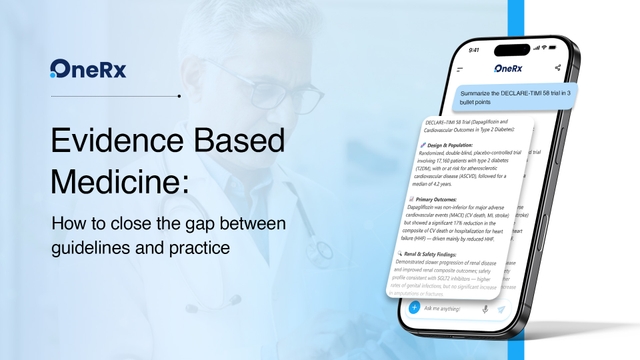
Evidence Based Medicine: How to Close the Gap Between Guidelines and Practice
Evidence Based Medicine has reshaped modern healthcare. Yet despite decades of progress, a practical problem remains: there is still a measurable gap between clinical guidelines and everyday clinical practice.
The challenge today is not the absence of evidence. It is the difficulty of applying that evidence consistently, efficiently, and responsibly at the point of care.
Closing this gap requires more than publishing new guidelines. It requires making evidence usable within real clinical workflows.
What Is Evidence Based Medicine?
The modern framework of Evidence Based Medicine (EBM) was formalized in the 1990s and integrates three essential components:
- Best available research evidence
- Clinical expertise
- Patient values and preferences
EBM emphasizes structured use of high-quality data while preserving clinician judgment. It was never meant to create algorithmic care. It was meant to support thoughtful and defensible medical decision making.
Why the Gap Between Guidelines and Practice Persists
Despite robust guidelines, variation in care remains documented across healthcare systems. The issue is not lack of evidence — it is usability.
- Guidelines are lengthy and frequently updated
- Recommendations include conditional nuances
- Subgroup analyses require interpretation
- Patient contexts rarely match trial populations perfectly
In busy clinics, navigating documents while managing consultation time creates cognitive strain. The challenge becomes operational rather than philosophical.
The Increasing Complexity of Medical Decision Making
Clinicians must now integrate expanding research evidence, new therapies, biomarkers, safety alerts, and institutional protocols — all while treating increasingly complex patients.
The tension between standardized evidence-based treatment and individualized patient care is growing. The gap emerges from difficulty in synthesis, not neglect of science.
The Role of Real World Evidence
Real world evidence complements randomized trials by clarifying outcomes in older populations, long-term tolerability, and performance in patients with comorbidities.
However, without structured synthesis, more data can increase uncertainty rather than reduce it.
A Practical Clinical Example
Consider a patient with type 2 diabetes, hypertension, and early chronic kidney disease. Guidelines provide structured recommendations.
Yet applying them requires balancing trial efficacy, renal dosing, drug interactions, adherence capacity, and socioeconomic factors — all within limited consultation time.
Why Evidence Based Medicine Struggles in Execution
- High cognitive load
- Fragmented information systems
- Interpretation variability
- Workflow disruption
The issue is not whether EBM works. The issue is whether it fits naturally into clinical workflow.
Making Evidence Based Medicine Usable
To close the gap, clinicians need:
- Structured access to guidelines
- Rapid comparison of trial evidence
- Integrated safety information
- Contextual patient relevance
These strengthen evidence-based clinical practice without diminishing professional autonomy.
The Role of Point of Care Decision Support
Structured decision support systems can organize guidelines, present referenced evidence transparently, and allow patient-specific input while maintaining physician oversight.
The objective is not automation. It is clarity.
Where OneRx Fits
OneRx is designed as an evidence-based clinical support platform for doctors, organizing guidelines, trial comparisons, dosing and safety protocols into a searchable interface.
It does not replace clinical judgment. It supports clinicians in applying Evidence Based Medicine more consistently within everyday workflow.
Conclusion
Evidence Based Medicine transformed healthcare by grounding decisions in structured research. The modern challenge is not generating evidence — it is applying it.
When evidence becomes usable — not just available — Evidence Based Medicine achieves its full potential.