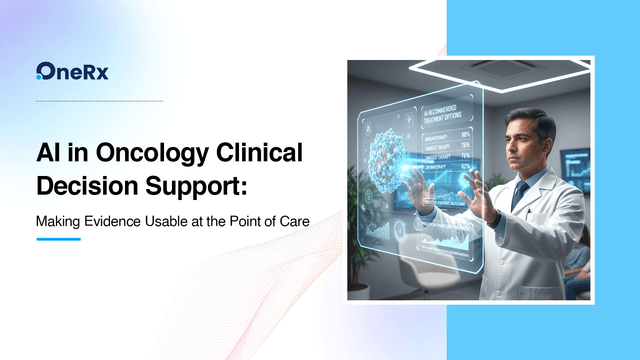
AI in Oncology Clinical Decision Support: Making Evidence Usable at the Point of Care
Modern clinical oncology is no longer constrained by lack of evidence. It is constrained by the volume of it.
Treatment algorithms evolve rapidly. Biomarker-driven therapies expand each year. Immunotherapy combinations shift standards of care within months. Updated oncology treatment guidelines are published frequently, and real-world data adds another layer of nuance.
This is where AI in oncology clinical decision support becomes clinically meaningful — not as a replacement for judgment, but as structured assistance in navigating complexity.
The Expanding Evidence Burden in Clinical Oncology
Oncology is uniquely evidence-dense. Between guideline updates, pivotal trials, subgroup analyses, biomarker refinements, and emerging toxicity management protocols, staying current requires continuous review.
Authoritative bodies such as:
- National Comprehensive Cancer Network
- American Society of Clinical Oncology
regularly update standards of care. These guidelines are foundational — but they are also lengthy, nuanced, and sometimes difficult to operationalize during a 10–15 minute consultation.
What Is Clinical Decision Support in Oncology?
Oncology decision support refers to tools designed to assist clinicians in applying evidence, guidelines, and trial data to individual patient scenarios.
Traditionally, this meant printed protocols, PDF guideline documents, institutional pathway manuals, and tumor board deliberation. While effective, these approaches are static. They rely heavily on individual recall and manual cross-referencing.
An oncology decision support system attempts to structure this process digitally, organizing:
- Staging frameworks (such as TNM systems)
- Biomarker-driven pathways
- Drug dosing and toxicity protocols
- Comparative trial outcomes
When AI capabilities are added, the system can interpret structured patient inputs, surface guideline-aligned options, compare trial evidence, and highlight safety considerations.
Why AI in Oncology Is Different from Generic AI
There is growing discussion around AI in oncology, but not all AI tools are clinically equivalent. Oncology requires tools that are grounded in:
- Guideline grounding
- Structured staging logic
- Biomarker integration
- Drug interaction awareness
- Toxicity grading familiarity
An effective AI in oncology clinical decision support system must be evidence-based, transparent in reasoning, and anchored in recognized standards such as NCCN and ASCO.
The Role of Oncology Treatment Guidelines — and Their Limitations
Oncology treatment guidelines remain the backbone of modern cancer care. They provide consensus-based recommendations informed by randomized controlled trials, meta-analyses, and expert panels.
However, guidelines are written for breadth. They must cover a wide range of scenarios. This creates several practical challenges:
- Length and Complexity
- Nuanced Footnotes
- Rapid Updates
- Individual Variation
AI-enabled systems can help by structuring and contextualizing these guidelines into searchable, patient-specific pathways.
Oncology Real World Evidence: Bridging Trials and Practice
Another growing component of modern care is oncology real world evidence.
While randomized trials define efficacy, real-world studies illuminate tolerability in older populations, adherence patterns, and variations across healthcare systems.
AI-driven oncology clinical intelligence platforms can assist by synthesizing multiple evidence layers into a single interface.
Point-of-Care Complexity: A Real Clinical Scenario
Consider a patient with Stage IV non-small cell lung cancer, high PD-L1 expression, multiple comorbidities, and mild hepatic impairment. The oncologist must evaluate multiple treatment options.
An effective oncology evidence platform should allow the clinician to input structured patient parameters and view guideline-aligned options, compare pivotal trial data, and review dosing and toxicity considerations.
Safety, Toxicity, and Medico-Legal Considerations
Cancer therapies carry significant toxicity risks. Dose modifications, hepatic adjustments, renal considerations, and immune-related adverse event management are critical.
An oncology decision support system that integrates toxicity grading frameworks and dosing protocols can improve consistency — particularly in busy practices.
Conclusion
AI in oncology clinical decision support represents a structural solution to cognitive overload — transforming guidelines and trial data into usable insight at the bedside.
When grounded in recognized standards, transparent methodology, and clinician oversight, AI becomes not a replacement for expertise, but an amplifier of it.