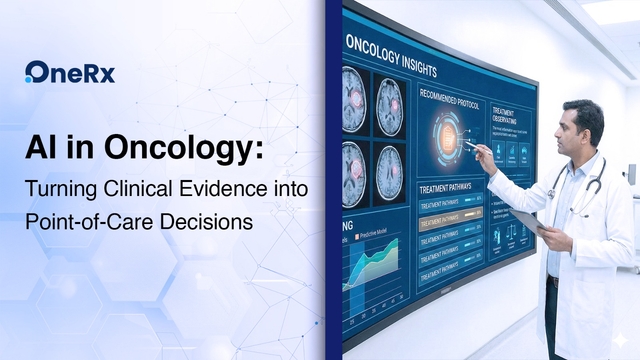
AI in Oncology: Turning Clinical Evidence into Point-of-Care Decisions
In clinical oncology, decisions are rarely simple or linear. Each patient encounter brings together staging details, pathology reports, molecular markers, prior lines of therapy, comorbidities, and patient preferences. All of this must be reconciled with rapidly evolving clinical evidence, often within minutes. As oncology care grows more complex, the challenge is no longer the lack of information, but the ability to apply the right evidence based medicine at the exact moment a decision is made. This is where AI in oncology is beginning to play a practical, supportive role.
The Reality of Decision-Making in Clinical Oncology
Every oncology decision carries long-term implications. Choices around therapy selection, sequencing, or escalation directly affect outcomes, toxicity, and quality of life. In real-world cancer care, clinicians operate under significant time pressure, balancing patient expectations with clinical responsibility.
Despite strong training, no oncologist can recall every guideline update or emerging data point. Variability in decision-making is often driven not by differences in expertise, but by uneven access to timely evidence. In clinical oncology, this gap between knowledge and application is one of the most persistent challenges.
Why Oncology Is Anchored in Evidence Based Medicine
Few specialties depend on evidence based medicine as heavily as oncology. Treatment decisions are guided by clinical trials, consensus frameworks, and international standards. Evidence in medicine ensures that care remains consistent, defensible, and aligned with best practices.
Beyond clinical outcomes, oncology decisions carry ethical and medico-legal weight. Deviating from established evidence without clear justification can place clinicians and institutions at risk. However, while evidence is abundant, translating it into consistent practice remains difficult, especially as guidelines continue to expand in depth and complexity.
Where Traditional Evidence Access Falls Short
Most oncology evidence is still accessed through static sources. Guidelines are distributed as long documents. Research findings are scattered across cancer research journals, including high-impact publications such as the journal of clinical oncology. While authoritative, these formats are not designed for point-of-care use.
In daily practice, clinicians often rely on memory, local protocols, or previously reviewed material. This leads to delays in adopting updated oncology treatment guidelines and increases variability in care. The issue is not lack of diligence, but structural inefficiency in how evidence is delivered.
Why Point-of-Care Oncology Decision Support Matters
Effective oncology decision support goes beyond information retrieval. A true oncology decision support system aligns evidence with real clinical workflows, presenting relevant guidance at the moment it is needed.
Rather than replacing clinical reasoning, decision support tools reinforce it. They help clinicians validate decisions, reduce oversight, and maintain consistency across teams, particularly in complex or borderline cases.
What AI in Oncology Really Means
There is widespread misunderstanding about medical oncology AI. AI does not diagnose cancer, prescribe treatment, or act autonomously. In responsible clinical settings, AI functions as an intelligence layer that structures, prioritizes, and contextualizes existing evidence.
When applied appropriately, AI in oncology supports clinicians by:
- Organizing large volumes of clinical data
- Mapping guidelines to patient-specific contexts
- Highlighting relevant considerations without dictating outcomes
Clinical judgment remains central. AI exists to support, not replace, expert decision-making.
Turning Clinical Evidence Into Oncology Clinical Intelligence
The real value of AI lies in its ability to convert raw data into oncology clinical intelligence. By using evidence AI, clinicians can navigate complex evidence hierarchies more efficiently.
This approach supports:
- Better guideline adherence
- Reduced cognitive burden
- Greater consistency in evidence application
Rather than overwhelming clinicians, AI helps filter what matters most in a given clinical scenario.
Supporting Accurate Cancer Staging With AI
Accurate staging underpins all oncology decisions. The TNM system for staging, including TNM grading and stage TNM classification, requires precise interpretation of clinical and pathological inputs.
AI does not assign stages independently. Instead, it assists clinicians by:
- Structuring staging criteria clearly
- Linking stage-specific evidence to treatment pathways
- Reducing interpretation variability across teams
This is especially valuable in multidisciplinary oncology settings.
The Role of Oncology Real World Evidence
While randomized trials remain foundational, oncology real world evidence offers critical insights into how treatments perform outside controlled environments. Patients in routine practice often differ significantly from trial populations.
Real world evidence pharma data helps contextualize outcomes, tolerability, and adherence patterns. AI supports responsible interpretation of this data, ensuring that real-world insights complement, rather than override, established evidence.
Practical Use Cases for an Oncology Evidence Platform
A modern oncology evidence platform adds value in everyday clinical scenarios, including:
- Reviewing evidence for rare or complex cancers
- Aligning decisions across multidisciplinary teams
- Supporting less experienced clinicians with structured guidance
- Keeping pace with frequent evidence updates
An oncology evidence platform for doctors is most effective when it integrates seamlessly into clinical workflows.
How Evidence Platforms Fit Into Oncology Workflows
In busy clinics, clinicians need rapid access to defensible evidence. A well-designed clinical evidence platform allows oncologists to engage with evidence based medicine platforms without stepping away from patient care.
This supports:
- Faster, more confident decisions
- Reduced reliance on outdated references
- Improved documentation of evidence-supported choices
Importantly, it standardizes care while preserving clinical autonomy.
The Future of Oncology Decision-Making
The future oncology landscape will involve increasing data complexity. Genomics, biomarkers, and real-world data will continue to expand. AI for oncology will increasingly function as clinical infrastructure, supporting evidence governance and consistency across care settings.
Rather than diminishing the clinician’s role, AI will help ensure that expertise is applied safely and uniformly.
A Responsible Note on AI in Cancer Care
AI systems in oncology are designed to support clinical decision-making. They do not provide medical advice, replace professional judgment, or assume clinical responsibility. Final decisions always rest with the treating clinician.
How Platforms Like OneRx Support Evidence-Based Oncology Care
In real clinical environments, oncologists need more than access to information. They need structured, defensible evidence delivered at the point of care. This is where platforms like OneRx focus their role.
OneRx is a doctors-only clinical evidence platform built to support evidence based medicine in daily oncology practice. It organizes clinical guidelines, peer-reviewed research, and real-world evidence into structured pathways aligned with oncology workflows.
Rather than acting as a generic AI chatbot or search engine, OneRx supports clinical oncology decision-making by improving consistency, confidence, and evidence governance. Importantly, it does not replace clinical judgment. It exists to help clinicians apply evidence responsibly in complex, time-sensitive scenarios.
Closing Perspective
Oncology demands accuracy, accountability, and consistency. AI in oncology, when designed responsibly, helps bring clinical evidence closer to the point of care. By supporting clinicians with structured intelligence, AI strengthens evidence-based practice while keeping expert judgment firmly at the center of cancer care.